


Classical Guitars

-
Hermann Hauser II - 1976 1014/a
Price on requestLuthier: Hermann Hauser IILuthier: Rare GuitarsConstruction Type: Traditional -
Richard Jacob Weissgerber - 1940 34. 1./7.
Price: 5.990 €Sale price 5.990 € Price:Unit price per Tax free (0% DE)0 €Save: -5.990 €Luthier: Richard Jacob WeissgerberConstruction Type: Traditional -
Walter Vogt - ca. 1970
Price: 3.990 €Sale price 3.990 € Price:Unit price per Tax free (0% DE)0 €Save: -3.990 €Construction Type: Traditional -
Stephan Connor - 2024 Lattice 64 cm
Price on requestLuthier: Stephan ConnorConstruction Type: Lattice -
Emanuele Faggion - 2026 Dreadnought Model
Price: 5.990 €Sale price 5.990 € Price:Unit price per Tax free (0% DE)0 €Save: -5.990 €Luthier: Steelstring guitarsConstruction Type: Traditional -
Armin Hanika - 2026 Natural Doubletop Custom 64 cm
Price: 4.990 €Sale price 4.990 € Price:Unit price per Tax free (0% DE)5.315 €Save: 325 €Manufacturer: Armin HanikaManufacturer: Armin HanikaConstruction Type: Double-Top Guitars -
Paolo Coriani - 2025 No. 274
Price: 12.490 €Sale price 12.490 € Price:Unit price per Tax free (0% DE)0 €Save: -12.490 €Luthier: Paolo CorianiConstruction Type: Traditional -
Siccas Luthiers - Creation Doubletop Spruce 63 cm
Price: 2.690 €Sale price 2.690 € Price:Unit price per Tax free (0% DE)0 €Save: -2.690 €Manufacturer: Siccas LuthiersManufacturer: Siccas LuthiersConstruction Type: Double TopConstruction Type: Double-Top GuitarsConstruction Type: Short Scale -

-
Armin Hanika - 2026 Natural Doubletop 64 cm
Price: 3.990 €Sale price 3.990 € Price:Unit price per Tax free (0% DE)4.950 €Save: 960 €Manufacturer: Armin HanikaManufacturer: Armin HanikaConstruction Type: Double-Top Guitars -
Vincent Humml - 2026 Doubletop No. 65
Price: 6.990 €Sale price 6.990 € Price:Unit price per Tax free (0% DE)0 €Save: -6.990 €ReservedLuthier: Vincent HummlConstruction Type: Double-Top Guitars -
Lorenzo Frignani - 2026 No. 274
Price: 13.990 €Sale price 13.990 € Price:Unit price per Tax free (0% DE)0 €Save: -13.990 €Luthier: Lorenzo FrignaniConstruction Type: Traditional -
Leonardo De Gregorio - 2024 Doubletop No. 250 64 cm
Price: 6.990 €Sale price 6.990 € Price:Unit price per Tax free (0% DE)0 €Save: -6.990 €Luthier: Leonardo De GregorioConstruction Type: Double-Top GuitarsConstruction Type: Short Scale -
Michel Brück - 1993 Solid Top No. 17
Price: 7.990 €Sale price 7.990 € Price:Unit price per Tax free (0% DE)0 €Save: -7.990 €Luthier: Michel BrückConstruction Type: Traditional -
Luigi Sabbatini - 2026 Lattice Edelweiss 64 cm
Price: 4.990 €Sale price 4.990 € Price:Unit price per Tax free (0% DE)0 €Save: -4.990 €Luthier: Luigi SabbatiniConstruction Type: LatticeConstruction Type: Short Scale -
Dario Garcia - 2022 La Leona
Price: 3.990 €Sale price 3.990 € Price:Unit price per Tax free (0% DE)0 €Save: -3.990 €Luthier: Dario GarciaConstruction Type: Traditional -
Marco Maguolo - 2026 Ducale Double Top No. 322 REG Limited Edition
Price: 9.990 €Sale price 9.990 € Price:Unit price per Tax free (0% DE)0 €Save: -9.990 €Roma Expo 2026Luthier: Marco MaguoloConstruction Type: Double-Top Guitars -

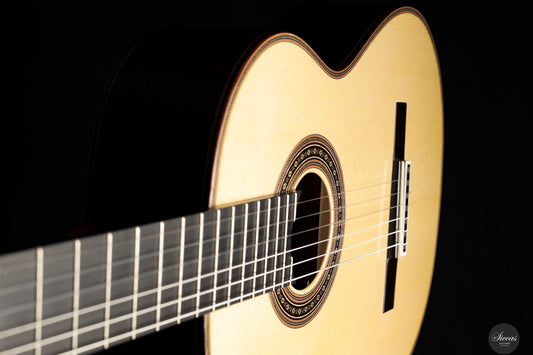 Roma Expo 2026
Marco Gilioli - 2026 Lattice REG No.74
Price: 8.990 €Sale price 8.990 € Price:Unit price per Tax free (0% DE)0 €Save: -8.990 €Roma Expo 2026Luthier: Marco GilioliConstruction Type: Lattice -

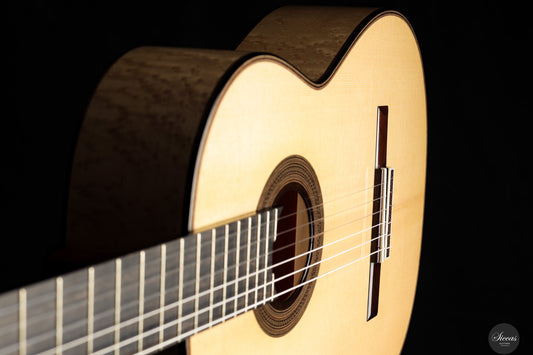 Roma Expo 2026
Sebastiano Fracasso - 2026 Dolomia REG 2026
Price: 7.990 €Sale price 7.990 € Price:Unit price per Tax free (0% DE)0 €Save: -7.990 €Roma Expo 2026Luthier: Sebastiano FracassoConstruction Type: Traditional -
Antonio Marchese - 2026 Garcia REG Limited Edition
Price: 9.990 €Sale price 9.990 € Price:Unit price per Tax free (0% DE)0 €Save: -9.990 €ReservedLuthier: Antonio MarcheseConstruction Type: Traditional -
Antonio Marchese - 2026 Arias REG Limited Edition
Price: 9.990 €Sale price 9.990 € Price:Unit price per Tax free (0% DE)0 €Save: -9.990 €ReservedLuthier: Antonio MarcheseConstruction Type: Traditional

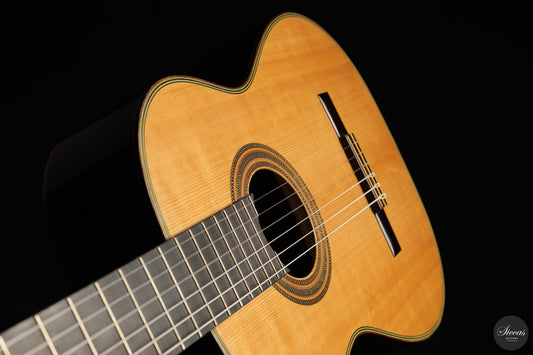

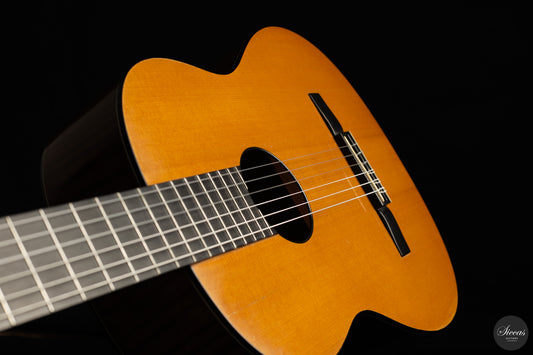

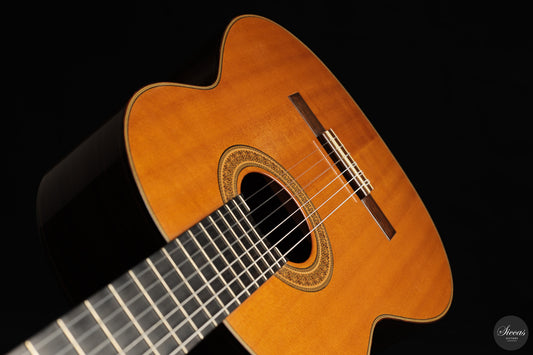

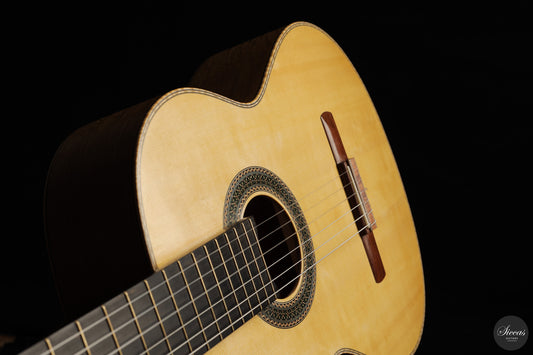

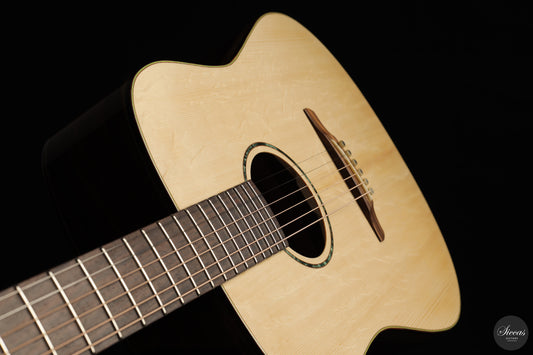

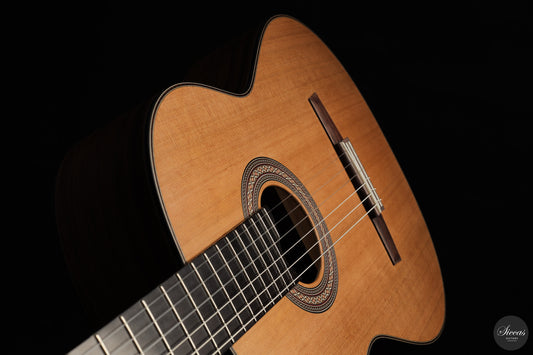















You may also be interested Classical Guitars
The Classical Guitar
The terms classical guitar, concert guitar, or Spanish guitar refer to the same instrument. However, classical guitars are strung with nylon strings, while acoustic or western guitars are strung with steel strings. Antonio de Torres (1817-1892) is considered a pioneer in modern guitar construction. He is recognized as the pivotal figure in modern guitar making. His instruments became the starting point for the development of classical guitars in the 19th and 20th centuries.
The revolutionary significance of Torres' guitar creation lies in size: as the body of the current six-string guitar requires a larger volume, he not only increased the back and sides, but also designed at least five different upper shapes to fit his guitar. Compared to his contemporaries' productions, almost all of these shapes have a larger range. Although Torres' guitars are larger, he aimed to keep the weight of the guitar as low as possible. With very thin boards, the cut at the thickest point is only 2.5 mm. To account for the fact that despite its low weight and thickness, the top can withstand string tension, he used fan bracing instead of the previous transverse bars. This strengthens the top and distributes the vibration across the surface.
The scale length, i.e., the length of the free-swinging string, is set at 65 cm, and the neck is assembled from several separate pieces to prevent warping. Torres widened the fretboard to give more space to the fingers of his left hand. To tune the guitar, he used a more accessible mechanism instead of wooden pegs.
The Classical Guitar is mainly used in classical music (especially chamber music) and folk music, Latin American music, and flamenco dance.
Music written specifically for the classical guitar dates back to the late 18th century when the sixth string was added (the Baroque guitar typically had five pairs of strings).
A History of the Classical Guitar: From Vihuela to Concert Hall
The modern classical guitar is the product of centuries of evolution, shaped by luthiers, composers, and performers across cultures and eras. Understanding this history enriches your relationship with the instrument and the music you play on it.
From Vihuela to Baroque Guitar (1500–1750)
The classical guitar’s ancestors include the four-course Renaissance guitar and the vihuela — a guitar-shaped instrument popular in 16th-century Spain. Composers like Luis de Narváez (born c. 1500) and Alonso Mudarra wrote sophisticated polyphonic music for the vihuela, much of it preserved in printed tablature from the 1530s–1550s. This body of work represents some of the earliest composed music for any plucked string instrument.
By the late 16th century, the five-course Baroque guitar had overtaken the vihuela. Strung with five pairs (courses) of strings, the Baroque guitar was smaller and brighter than today’s instrument. Its golden age produced extraordinary composers: Robert de Visée (born c. 1655 in France), who served as chamber musician to Louis XIV at Versailles, wrote elegant suites of dances that remain cornerstones of the guitar repertoire. Gaspar Sanz (born 1640 in Spain) published his landmark Instrucción de Música sobre la Guitarra Española in 1674, codifying Spanish guitar technique for generations.
Meanwhile in England, the lute tradition of John Dowland (born 1563) produced some of the most exquisite solo music of the Renaissance. Dowland’s works have been transcribed so successfully for modern guitar that they are now standard repertoire for classical guitarists worldwide.
The Classical and Romantic Periods (1750–1900)
The transition from five courses to six single strings occurred gradually during the late 18th century, creating the instrument we recognize today. This six-string guitar became the vehicle for a remarkable explosion of composed music.
Fernando Sor (1778–1839), born in Barcelona and educated at the Montserrat monastery, is often called the “Beethoven of the Guitar.” His training in classical counterpoint gave his compositions a structural depth unprecedented for the instrument. After supporting the French during the Napoleonic occupation of Spain, Sor was forced into exile, settling in Paris via London and Russia. His Op. 60 studies remain foundational for every classical guitarist.
Mauro Giuliani (1781–1829), born in Bisceglie, Italy, brought Viennese Classical style to the guitar. In Vienna he moved in the circles of Beethoven, Hummel, and Diabelli, and even premiered Beethoven’s Seventh Symphony as an orchestral cellist. His guitar concertos rival Sor’s works in ambition and craftsmanship.Dionisio Aguado (1784–1849), born in Madrid, was Sor’s great friend and intellectual rival. Their technical approaches differed — Aguado championed fingernail technique while Sor preferred flesh alone — but their mutual respect was profound. Sor composed the duet Les Deux Amis to honor their friendship. Aguado’s pedagogical legacy, including his invention of the tripodison guitar support, directly shaped modern technique.
Johann Kaspar Mertz (1806–1856) from Slovakia brought the Romantic piano tradition of Chopin and Schumann to the guitar, composing virtuosic works of extraordinary emotional depth.
The late 19th century brought a pivotal figure: Francisco Tárrega (1852–1909), born in Villarreal, Spain, widely regarded as the father of modern classical guitar technique. Tárrega established the playing position, tone production methods, and transcription practices that remain standard today. His compositions — Lágrima, Recuerdos de la Alhambra, Capricho Árabe — are among the most performed works in the repertoire. His students Miguel Llobet and Emilio Pujol transmitted his methods to the 20th century.
Antonio de Torres: The Stradivari of the Guitar
Antonio de Torres Jurado (1817–1892) is to the guitar what Stradivari is to the violin. Working in Seville and later Almería, Torres fundamentally redesigned the instrument, creating the template that every modern classical guitar follows.
Torres’s revolutionary innovations included a significantly larger body for greater volume and projection; remarkably thin soundboards (as little as 2.5mm at the thickest point); the fan-bracing system that replaced earlier transverse bar patterns, distributing vibration across the entire soundboard while maintaining structural integrity under string tension; the standardized 650mm scale length still used today; multi-piece neck construction to prevent warping; a wider fretboard for left-hand comfort; and geared mechanical tuners replacing wooden pegs. Every classical guitar built since Torres is, in fundamental ways, a Torres guitar.
The 20th Century to Today
Andrés Segovia (1893–1987) carried Tárrega’s legacy to the world stage, commissioning works from major composers including Federico Moreno Torroba, Joaquín Rodrigo, Mario Castelnuovo-Tedesco, and Manuel Ponce, dramatically expanding the concert repertoire.
Agustín Barrios Mangoré (1885–1944) from Paraguay composed over 300 works infusing classical form with the rhythms and harmonies of Latin American folk music. His La Catedral remains one of the most performed guitar sonatas.
Heitor Villa-Lobos (1887–1959), Brazil’s most important composer, wrote the 12 Etudes and 5 Preludes that represent landmarks of 20th-century guitar music. His fusion of European classical training with Brazilian folk tradition produced a compositional voice utterly unique in the instrument’s history.
Julian Bream (1933–2020) persuaded nearly every major British composer — from William Walton and Benjamin Britten to Peter Maxwell Davies — to write for the guitar, single-handedly establishing a British classical guitar repertoire.
Other towering figures include Leo Brouwer (Cuba), Antonio Lauro (Venezuela), and Enrique Solares (Guatemala). Contemporary composers like Nikita Koshkin, Roland Dyens, and Carlo Domeniconi continue expanding the boundaries. Joaquín Rodrigo’s Concierto de Aranjuez (1939) remains the most famous guitar concerto ever written — its Adagio second movement is one of the most recognized melodies in classical music.
Anatomy and Construction of a Classical Guitar - The Soundboard (Top): Where Tone Begins
Understanding how a classical guitar is built helps you make informed buying decisions and appreciate the craftsmanship behind every instrument.
The soundboard is the single most important tonal component — approximately 70% of the guitar’s sound character is determined by the top wood and its construction.
Spruce (Picea). The most traditional top wood, used by Torres and virtually every major luthier since. Spruce produces a bright, brilliant tone with excellent clarity and projection. It has a high stiffness-to-weight ratio, translating to wide dynamic range. Spruce tops require playing time to “open up” — the overtone spectrum becomes richer over months and years. This ongoing development is why well-played spruce-top guitars can sound extraordinary after decades.
Cedar (Thuja plicata). Cedar tops produce a warmer, darker, more immediately responsive tone. The complex overtone spectrum is present from the start, without the extended break-in period. Cedar is more forgiving of lighter touch, making it popular with beginners and fingerstyle players. However, cedar reaches its tonal peak more quickly and does not develop the same bright treble brilliance as spruce over time.
Other top woods. Some luthiers experiment with redwood (even warmer than cedar), various European spruce species (lighter and more responsive than Sitka), and occasionally cypress (traditionally used for flamenco guitars, producing a bright, percussive sound). The highest-quality tops feature fine, evenly distributed, narrow growth rings — an indicator of slow, even growth that produces wood with optimal stiffness and resonance.
Bracing: The Hidden Architecture
Beneath the soundboard lies a system of thin wooden struts called bracing, which strengthens the top against string tension while shaping how vibrations travel. Torres’s seven-fan bracing pattern remains the foundation, but modern luthiers have developed numerous variations: lattice bracing (using carbon fiber or Nomex for maximum projection), double-top construction (two ultra-thin layers sandwiching a Nomex honeycomb core), and asymmetric fan patterns designed to balance treble and bass response.
Back and Sides: Shaping the Voice
The back and sides contribute approximately 30% of the total resonance. Their primary role is to reflect sound back through the soundboard.
Indian Rosewood: Balanced, rich, excellent sustain. The most common choice. Spruce or cedar — the standard combination. Brazilian Rosewood: Complex overtones, legendary resonance. Extremely rare, CITES-protected. Spruce — the holy grail tonewood pairing. Mahogany: Warm, focused midrange, less treble brilliance. Cedar for maximum warmth; spruce for balance. Maple: Clear, bright, immediate response with less sustain. Spruce for maximum clarity and projection. Cypress: Bright, percussive, immediate. Traditional for flamenco. Spruce — the classic flamenco combination. Cocobolo: Rosewood-like with more sparkle and treble definition. Spruce or cedar — increasingly popular alternative.
Note: Brazilian rosewood (Dalbergia nigra) has been CITES Appendix I since 1992, restricting international trade. Indian rosewood (Dalbergia latifolia) was added to CITES Appendix II in 2017, requiring documentation for cross-border trade. These regulations have driven increased interest in alternative tonewoods like cocobolo, ziricote, and Madagascar rosewood.
The Neck, Fretboard, and Hardware
Neck: typically crafted from Spanish cedar or mahogany for stability and warp resistance. Some modern guitars include a truss rod for adjustable neck relief — increasingly common in crossover instruments.
Fretboard: traditionally rosewood or ebony (denser, smoother, preferred on premium instruments). Alternatives like Indian laurel, walnut, and composite materials are gaining acceptance due to rosewood trade restrictions.
Tuning machines: geared tuning machines (open-gear or enclosed) from makers like Gotoh, Schaller, and Sloane provide precise, stable tuning.
Nut and saddle: bone is the traditional and tonally superior material. The nut width on a standard classical guitar is 52mm (compared to 43–44mm on steel-string acoustics), providing the extra spacing essential for classical technique.
How to Choose a Classical Guitar: A Buyer’s Framework
The standard scale length is 650mm (25.6″), established by Torres and unchanged for over 150 years. Players with smaller hands or younger players should choose proportionally sized instruments:
1/4 size ~480 mm ages 4–6. Smallest; for the youngest beginners. 1/2 size ~530 mm ages 5–8. Common first-guitar size for children. 3/4 size ~580 mm ages 8–11. Most popular children’s size. 7/8 size ~630 mm ages 11–13. Small adults, Reduced scale, full-quality tone. Full (4/4) 650 mm ages 13+. Standard adult instrument.
Spruce vs Cedar: Which Top Wood Is Right for You?
Tone color spruce: Bright, brilliant, clear Tone color cedar: Warm, dark, rich Dynamic range spruce: Wide — rewards developed technique Dynamic range cedar: More even — forgiving of lighter touch Break-in period spruce: Needs months/years to open up Break-in period cedar: Sounds full from day one Long-term development spruce: Continues improving for decades Long-term development cedar: Reaches peak relatively quickly Projection spruce: Excellent in larger rooms Projection cedar: Better in intimate settings
The Classical Guitar – Which Wood is Suitable for Me and My Ideal Sound?
The selection of wood, especially for the top, the craftsmanship by the manufacturer, and the finishing are crucial for the sound characteristics and quality of a concert guitar or classical guitar. For very high-quality instruments, spruce or cedar wood with fine, evenly distributed, and narrow growth rings is mainly used for the top. Other types of wood are also used depending on the desired sound. Cedar wood produces a slightly warmer timbre with complex overtones. Mahogany wood sounds warmer and slightly less overtone-rich than spruce. The choice of top wood is thus a matter of specific tonal preferences. For the sides, top, and back, mahogany, rosewood, cedar, or maple are used. The neck is usually made of cedar, mahogany, or another wood such as rosewood or maple. The preferred wood for the fretboard is rosewood, less commonly ebony. Walnut, Indian laurel, and Micarta are increasingly used for fretboards as well. Notably, rosewood has been listed in CITES Appendix Two for protected woods since February 2017.
Back and Side Wood for a Classical Guitar
Approximately 30% of the total resonance volume of concert guitars is determined by the choice of sides and back. Typically, mahogany, rosewood, and maple are used. Rosewood, with its very high wood density, combined with a spruce top, provides a very balanced sound. In contrast, the same model with mahogany sides and back yields a significantly warmer sound in the bass and midrange, but less brilliance in the treble. Sides and back made of maple provide a very clear sound with a direct response.
The Top Wood of Classical Guitars
For classical guitars, two types of top woods are distinguished, each producing a different sound from the ground up. The widely used spruce top sounds brighter and more brilliant in the higher frequencies and requires significantly more playing time to develop a fuller overtone spectrum compared to the much darker-sounding cedar top. The cedar top vibrates much more voluminously and warmly than spruce but will not develop the same clear brilliance in the treble even after extended play.
Do I Need a Pickup?
For most classical guitarists, no. Classical guitar is primarily an acoustic art. However, for amplified performance or recording, there are three main pickup technologies:
Piezo pickups (under the saddle) are affordable, feedback-resistant, and practical for stage use. They capture string vibration directly but miss the body’s natural resonance, often producing a characteristically “quacky” amplified tone.
Soundboard transducers (mounted on the top’s underside) capture the soundboard’s vibration, producing a warmer, more natural tone. More feedback-prone than piezo but significantly better-sounding for recording and intimate amplified settings.
Internal condenser microphones produce the most natural amplified tone, capturing the full acoustic character including body resonance and air movement. Most feedback-prone; typically found in premium instruments.
Modern systems often blend two technologies (piezo + microphone) with active preamps featuring built-in tuners, EQ, notch filters, and phase switches for maximum control.
What are the Pros and Cons of a Cutaway?
A cutaway is a sculpted indentation in the lower bout providing easier access to the upper frets (12th and above). Most classical repertoire rarely requires playing above the 12th fret, so traditional classical guitars omit the cutaway. The tradeoff: a cutaway removes a small portion of the soundboard, slightly reducing acoustic volume and bass response.
Florentine cutaway: pointed shape. Venetian cutaway: rounded shape, more common on classical instruments. Both achieve the same function; the choice is primarily aesthetic.
The Classical Guitar as a Beginner's Instrument
A classical guitar is the perfect entry into playing the guitar, as the much softer nylon strings are much easier for beginners to fret than the thin and stiff steel strings of a steel-string or electric guitar. Concert guitars are also available in sizes 1/4, 1/2, 3/4, 4/4, and 7/8, allowing even the youngest players to find a comfortable and ergonomically suitable instrument.
What Makes Siccas Guitars Special?
At Siccas Guitars, you can buy high-quality classical guitars, Spanish guitars, concert guitars. In contrast to many other retailers, Siccas Guitars focuses on high-quality master guitars and rare guitars, such as those by Hermann Hauser I, Hermann Hauser II, Hermann Hauser III, Daniel Friederich, José Ramirez, Paulino Bernabé, Santos Hernandez, Domingo Esteso, Enrique Garcia, showcased on www.siccasguitars.com and via social media channels. Customers can watch lovingly produced videos on YouTube and the website. These videos feature masterful musicians such as Ana Vidovic, Tatyana Ryzhkova, Isabella Selder, Julia Trintschuk, Stephanie Jones, Cyprien N’tsaï, Alexandra Whittingham, Carlotta Dalia, Julia Lange, Judith Bunk, Roman Viazovskiy, Valeria Galimova, Natalia Lipnitskaya, Edson Lopes, and many more. Siccas Guitars specializes in master guitars, acoustic guitars, and historical guitars from around the world. They also have a large assortment of concert and student guitars from brands such as Hanika, Duke, Altamira, Raimundo, etc., to provide young talents and hobby musicians with optimal equipment. Together with their customers, they want to develop new ideas and share experiences.
Buying Guitars: Your Guide to Acquiring the Perfect Instrument
Guitars have been one of the most beloved instruments on the market for years. From beginners to professionals, the guitar offers opportunities for anyone looking to make music. Whether you're looking for an electric, acoustic, or steel-string guitar, here are the best tips for buying a guitar.
Classical Guitars: Ideal for Beginners
The concert guitar is often the first choice for beginners. With soft nylon strings and a wider fretboard, it's comfortable to play. If you're new to the world of music, a concert guitar is a cost-effective entry point.
Steel-String Guitar: For Blues and Folk Songs
The steel-string guitar is suitable for those who want to play with steel strings. If you’re heading towards blues or folk, this type of guitar is ideal. Your fingers will adjust to the steel strings after a short period, so don’t let this hold you back.
Electric Guitars: Perfect for Rock and Metal
The electric guitar is a dream for rock and metal enthusiasts. Connect it to an amplifier and experiment with different sounds. Rock stars love electric guitars because of their versatility, and so can you.
Guitar Accessories: What Do You Need?
You can’t play the guitar without the right accessories. Invest in guitar picks, straps, and a bag for easy transportation. If you’re planning to play electric, an amplifier is a must. And don’t forget spare strings, a tuner, and a metronome to keep your guitar in top shape.
Buying Guitars: New vs. Used
New guitars offer the latest technology and modern features. Used guitars can provide vintage sound and character. Consider your budget and preferences when deciding between new and used guitars.
Choosing the Perfect Guitar
Buying a guitar is a personal decision. Consider the type of music you want to play and your skill level. Visit music stores to try different guitars and find the one that feels right in your hands. With the right guitar, your musical journey will be off to a great start.
The world of classical guitars is rich and diverse, offering a wide range of options for players of all levels. Whether you're a beginner, an intermediate player, or an advanced guitarist, finding the right classical guitar involves considering factors like wood type, sound characteristics, and additional features like pickups. To make an informed decision, it's important to try out different guitars, explore various brands, and seek guidance from experienced players or professionals. With the right instrument, you'll be able to enjoy the beautiful tones and versatility that the classical guitar has to offer.
For more information and a curated selection of high-quality classical guitars, explore reputable retailers like Siccas Guitars, who specialize in providing options to suit different preferences and playing styles.
Happy playing and exploring the wonderful world of classical guitars!