







Santos Hernandez - 1925
Santos Hernandez - 1925


Details
Details
Overview
Overview
Shipping important note
Shipping important note
Important: Additional costs such as import taxes and custom duties may occur when importing goods from the EU into your country.
Delivery times are typically reliable and most instruments arrive within the estimated timeframe.
Should any unexpected delay occur, our team will keep you informed and provide support at every step. For all shipping details and exceptions, please see our Shipping Policy.
Details about GPSR
Details about GPSR


Video overview


More details about the guitar
About the luthier
Santos Hernández was born in Madrid in 1873 and began his apprenticeship at an early age in the workshop of Valentín Viudes before continuing his training in José Ortega’s Granadinian workshop. After periods spent in several workshops and compulsory military service, he assumed Enrique García’s position at Manuel Ramírez’s workshop in 1905. His contribution to the construction of Andrés Segovia’s celebrated 1912 Manuel Ramírez guitar established his reputation as one of the most important Spanish guitar makers of his generation.
Following Manuel Ramírez’s death, Hernández continued working for his widow alongside Domingo Esteso. In 1921, he opened his own workshop, marking the beginning of an independent period that would produce some of the most sought after Spanish guitars of the early twentieth century. His work is characterised by a Torres influenced structural approach, refined craftsmanship and a tonal ideal that has remained a reference point for generations of makers.
About the guitar
This guitar was built in 1925 and represents a mature example of Santos Hernández’s independent work. Constructed with a spruce top and Brazilian rosewood back and sides, it is exceptionally light in weight, a characteristic closely associated with Hernández’s most responsive instruments from this period.
The tonal character is distinctly vintage and immediately recognisable. The basses are not only deep but notably singing, supported by a very low body resonance that gives the instrument a sense of depth and openness. Despite this resonance, the sound remains controlled, with clear separation between notes and a focused core to each pitch. The overall colour is slightly dark and smooth rather than bright, yet never blurred.
Across the registers, the guitar offers strong balance and a refined sense of space between notes, allowing inner voices and phrasing details to emerge naturally. The response encourages expressive playing and rewards subtle articulation, making the instrument particularly compelling for players seeking an authentic early twentieth century Spanish voice.
Condition
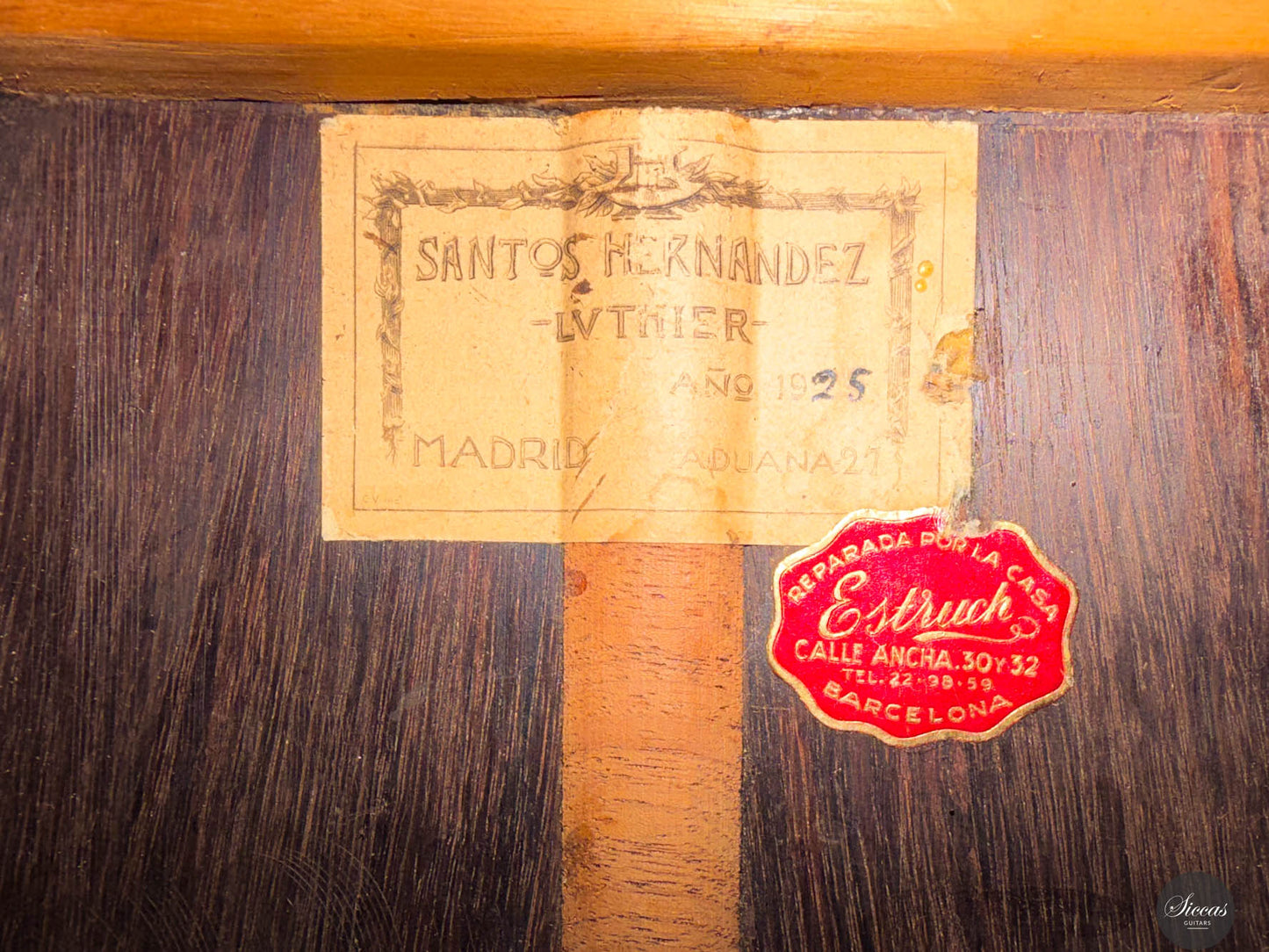
The guitar has been professionally repaired and is structurally stable. It carries an additional internal seal reading “Reparada por Casa Estrada, Calle Ancha 30 y 32, Barcelona,” indicating historical restoration work carried out by Casa Estrada.
Several cracks are present on the top, including two running from below the bridge to the lower edge, one to the right of the rosette, cracks on both sides of the fingerboard, and a possible short crack in front of the bridge. A small crack is also present on the side near the lower bout. All cracks have been professionally repaired without the use of cleats, which is considered a positive aspect in historical restoration.
On the back, a crack runs close to the right bout from the upper to the lower section. Additionally, a section of the back has been replaced with a well matched piece of wood, with possibly a single cleat near the tip of the replaced area. The tuners are original.
The finish consists of a combination of nitrocellulose and shellac applied across the instrument.
Regular care extends the life of the instrument
Even with careful use, a classical guitar may gradually change in appearance or respond to unstable storage conditions. Have a close look at your guitar regularly and be attentif to changes. If your instrument is suffering from its environement, it will let you know.
Protect Your Guitar: Handle with Care
Be mindful when touching your instrument with greasy or unwashed hands: any skin contact is a small attack on the varnish. Of course, a guitar is made to be played, but taking a few precautions helps preserve its beauty: wash your hands before playing, wear long sleeves, and avoid unnecessary direct skin contact with the body of the instrument.
Pro tip: Avoid playing with a button-up shirt, heavy jewelry, or a belt, as these can scratch the guitar. Also, make sure your guitar case is free of any objects that could damage the instrument during storage.
String care
A good habit to adopt is wiping down your strings briefly after each playing session. This small action significantly extends their lifespan and helps maintain a consistent, comfortable feel under your fingers.
Most importantly, clean strings are essential for keeping your instrument in tune. Corrosion, sweat, and dust can affect the uniformity of the strings and interfere with accurate tuning across the entire fingerboard.
Pro tip: If you're having trouble getting your guitar in tune, it might be time to change the strings. A useful test is to compare the pitch of the 12th fret harmonic with the fretted note at the 12th fret; if there's an unusually large gap between them, your strings may have lost their integrity and should be replaced.
Keep Your Shellac Finish Shining!
Got a guitar with a shellac (French polish) finish? Here's a simple trick: Take a clean microfiber cloth and gently breathe on the surface to create a light mist. Then, softly rub to remove fingerprints, sweat, and grease. That’s usually all it takes to keep it looking great, no products needed!
Pro tip: Every few years, treat your guitar to a check-up with a luthier to keep it in top shape.
Storing Your Guitar: Climate Matters
Your guitar can safely stay outside its case, as long as the surrounding environment maintains 42–55% humidity and a temperature between 18–25°C.
Keep in mind that humidity levels can still fluctuate inside the case, especially during seasonal changes.
- Too much humidity may cause overtightened strings and a dull tone.
- Too little humidity can lead to a bulging top, string buzz, or even cracks.
Avoid placing your guitar near radiators, air conditioners, or windows with direct sunlight.
Pro tip: Always close your guitar case while playing. This helps preserve a stable microclimate inside the case, so your instrument is protected the moment you put it back in.