







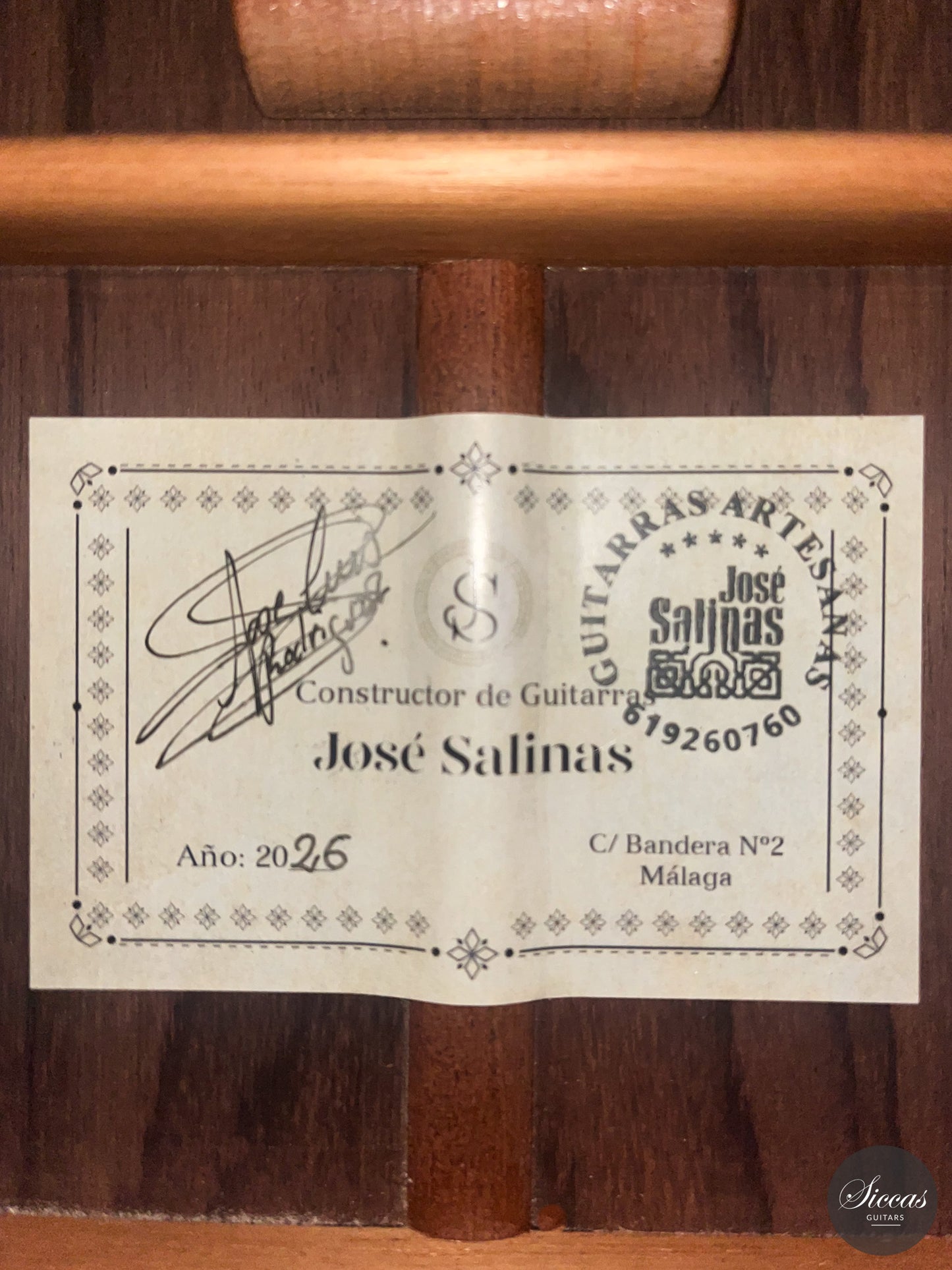
José Salinas - 2026 - 64 cm
José Salinas - 2026 - 64 cm


Details
Details
Overview
Overview
Shipping important note
Shipping important note
Important: Additional costs such as import taxes and custom duties may occur when importing goods from the EU into your country.
Delivery times are typically reliable and most instruments arrive within the estimated timeframe.
Should any unexpected delay occur, our team will keep you informed and provide support at every step. For all shipping details and exceptions, please see our Shipping Policy.
Details about GPSR
Details about GPSR


Video overview


More details about the guitar
About the luthier
José Salinas began his musical life as a flamenco singer at the age of seventeen at the Peña Flamenca Antonio de Torres in Almería, where he immersed himself in the traditional forms and rhythmic language of flamenco. His professional career started in 1998 after an appearance at the Feria de Almería. He later continued his artistic development in Madrid, performing in renowned tablaos and collaborating with leading flamenco dancers on international tours across Europe, Asia, Africa, and the United States.
Throughout these years he worked closely with distinguished guitarists and encountered many exceptional instruments, which deepened his understanding of tone, projection, and musical response. Parallel to his artistic path, Salinas trained as a cabinetmaker in his father’s workshop in Almería, developing a precise and respectful approach to wood as a material. The combination of musical sensitivity and technical craftsmanship eventually led him to guitar making. After building his first instruments, he opened his own workshop in 2014. Today he works in Málaga, in Rincón de la Victoria. While rooted in flamenco tradition, he also develops carefully built classical concert models that reflect his broad musical experience and structural understanding of the instrument.
About the guitar
This classical concert model from 2026 was developed exclusively for Siccas Guitars and is built in traditional construction with a spruce top and Indian rosewood back and sides. The visual concept is refined and restrained, with discreet decorative elements that underline its Spanish character without excess.
Tonally, the instrument presents a distinctly Spanish colour. The trebles are warm and lyrical, with a rounded contour and a gentle sweetness while remaining clear and projecting. The sustain is remarkably even across all registers, allowing melodic lines to unfold naturally and maintaining consistent note length throughout the fingerboard.
Despite its traditional construction, the response is immediate and forward. The sound carries a stable fundamental core in every position, so shifts along the fingerboard do not alter the intensity of the voice. The shorter 64 cm scale length contributes significantly to playing comfort and ease of articulation, while preserving clarity and projection. The result is a classical guitar that combines historical tonal character with modern balance and reliability.
Regular care extends the life of the instrument
Even with careful use, a classical guitar may gradually change in appearance or respond to unstable storage conditions. Have a close look at your guitar regularly and be attentif to changes. If your instrument is suffering from its environement, it will let you know.
Protect Your Guitar: Handle with Care
Be mindful when touching your instrument with greasy or unwashed hands: any skin contact is a small attack on the varnish. Of course, a guitar is made to be played, but taking a few precautions helps preserve its beauty: wash your hands before playing, wear long sleeves, and avoid unnecessary direct skin contact with the body of the instrument.
Pro tip: Avoid playing with a button-up shirt, heavy jewelry, or a belt, as these can scratch the guitar. Also, make sure your guitar case is free of any objects that could damage the instrument during storage.
String care
A good habit to adopt is wiping down your strings briefly after each playing session. This small action significantly extends their lifespan and helps maintain a consistent, comfortable feel under your fingers.
Most importantly, clean strings are essential for keeping your instrument in tune. Corrosion, sweat, and dust can affect the uniformity of the strings and interfere with accurate tuning across the entire fingerboard.
Pro tip: If you're having trouble getting your guitar in tune, it might be time to change the strings. A useful test is to compare the pitch of the 12th fret harmonic with the fretted note at the 12th fret; if there's an unusually large gap between them, your strings may have lost their integrity and should be replaced.
Keep Your Shellac Finish Shining!
Got a guitar with a shellac (French polish) finish? Here's a simple trick: Take a clean microfiber cloth and gently breathe on the surface to create a light mist. Then, softly rub to remove fingerprints, sweat, and grease. That’s usually all it takes to keep it looking great, no products needed!
Pro tip: Every few years, treat your guitar to a check-up with a luthier to keep it in top shape.
Storing Your Guitar: Climate Matters
Your guitar can safely stay outside its case, as long as the surrounding environment maintains 42–55% humidity and a temperature between 18–25°C.
Keep in mind that humidity levels can still fluctuate inside the case, especially during seasonal changes.
- Too much humidity may cause overtightened strings and a dull tone.
- Too little humidity can lead to a bulging top, string buzz, or even cracks.
Avoid placing your guitar near radiators, air conditioners, or windows with direct sunlight.
Pro tip: Always close your guitar case while playing. This helps preserve a stable microclimate inside the case, so your instrument is protected the moment you put it back in.