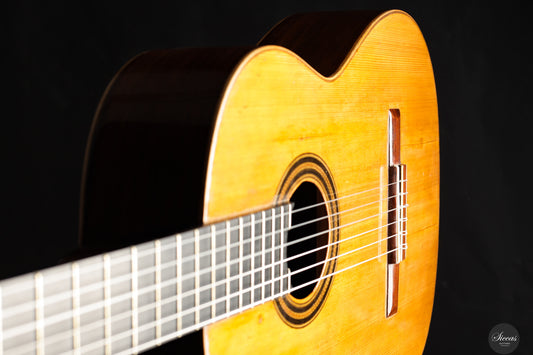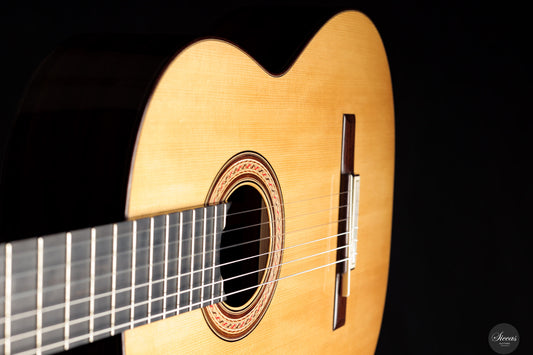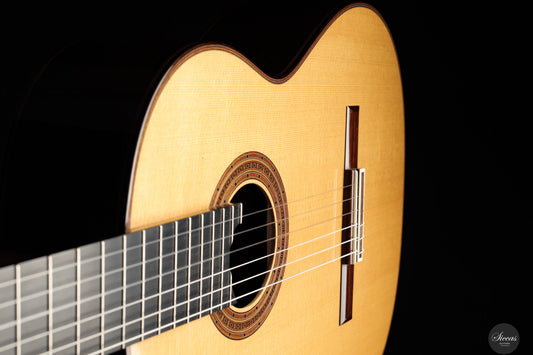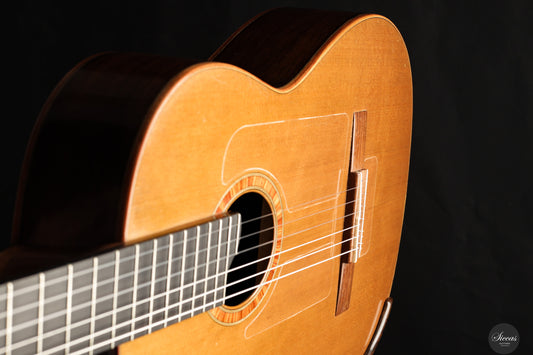


The Hermann Hauser guitar maker family
Josef Hauser (1854–1939)
Josef Hauser was born in Burghausen as the son of an innkeeper. After completing grammar school, he trained as both a merchant and a carpenter. Alongside his apprenticeship, he received musical instruction from the respected zither teacher Josef Wimmer. Hauser soon began composing his own works for zither, developed a reputation as a teacher, and later appeared as a concert virtuoso.
While living in Erding near Munich, Hauser rented an old barn and built his first zither. Once completed, he traveled to Munich and presented the instrument at the residence of Duke Maximilian of Bavaria, a prominent patron of the zither. The Duke played the instrument with Hauser throughout the night and dismissed him the following day with a letter of recommendation. Encouraged by this encounter, Hauser chose to pursue instrument making as a profession, describing himself with pride as a zither maker. Over time, his workshop expanded to include the construction of zithers, guitars, mandolins, violins, and lutes.
In 1875, Hauser founded his own publishing house for zither music to disseminate his compositions, many of which were rooted in folk tradition. After marrying the daughter of a potter, he relocated his workshop and publishing business to Munich. His work gained formal recognition in 1898, when he received a major medal at the Joint Music Exhibition in Berlin, followed by the Medal for Art and Science awarded by Duke Maximilian of Bavaria.
Hermann Hauser I (1882–1952)
Hermann Hauser I, the son of Josef Hauser, became one of the most influential guitar makers of the twentieth century. He learned instrument making in his father’s workshop and later assumed responsibility for it, while Josef Hauser focused on the publishing house. Hauser I specialized in the construction of guitars and lutes, while continuing the production of zithers.
Within the Bavarian guitar movement, he developed a wide range of guitar models, including Viennese and Munich forms, all built with notable precision. His prime guitars, terz guitars, and the rare quint-bass guitars remain admired for their sound quality. Hauser I introduced patented innovations in soundboard construction and in the connection between neck and body, reflecting his systematic and technically refined approach.
His work attracted the attention of leading Spanish guitarists of the early twentieth century, including Miguel Llobet and Andrés Segovia. Their collaboration marked a decisive moment in the history of the classical guitar. Like Antonio de Torres, Hermann Hauser I shaped the development of the modern concert guitar and influenced generations of luthiers. Many of his instruments were named after the artists who inspired them, such as the Llobet, Segovia, and Bream models.
The guitar played by Segovia between 1937 and 1970 is now preserved in the Metropolitan Museum of Art in New York. After the severe bombing of Munich during the Second World War, Hauser I relocated his workshop to Reisbach in Lower Bavaria.
Hermann Hauser II (1911–1988)
Hermann Hauser II received his formal training at the State Vocational School for Violin Making in Mittenwald and joined his father’s workshop in 1930. For many years, father and son worked closely together, and all instruments continued to bear the signature of Hermann Hauser I.
After more than two decades of collaboration, Hauser II took over the workshop in 1952. Instruments signed by him are numbered from approximately 500 to 1050. He continued and refined the classical models established by his father, while also developing new forms in close cooperation with leading guitarists.
Hauser II’s guitars were sought after by the same virtuosos who had valued the instruments of Hermann Hauser I, as well as by musicians of his own generation. His close relationships with artists such as Andrés Segovia, Julian Bream, and Django Reinhardt strongly influenced his work. One of his most significant instruments, built in 1957, was played by Julian Bream from 1959 to 1963 and appears on important recordings, including works by Albéniz, Scarlatti, Rodrigo, Frescobaldi, Ravel, and Roussel in the edition “The Art of Julian Bream”.
Hermann Hauser III (born 1958)
Hermann Hauser III continues the family philosophy first articulated by Hermann Hauser I: to build only a limited number of instruments each year in order to ensure quality and to work closely with a select group of dedicated artists. From 1974 onward, father and son built their instruments independently within the same workshop, with Hauser III introducing his own numbering system and signature.
His work has been praised by leading musicians. Andrés Segovia commented on the beauty of his sound, while Pepe Romero described his Hauser guitar as offering a particularly pure classical tone. Hauser III works in close collaboration with performers, carefully adapting each instrument to the player’s tonal preferences and technical requirements.
Before finalizing neck profiles, fingerboards, or scale length, he analyzes the guitarist’s technique and artistic goals. His study of historical instruments, particularly those built by earlier generations of the Hauser family, informs both his restoration work and the development of limited special editions.
Each guitar requires between 150 and 240 hours of work, with a maximum annual output of around seventeen instruments. The waiting period for a new guitar is approximately five years. As Andrés Segovia once wrote in the Hauser family guestbook, a Hauser guitar becomes “a friend for the rest of your life”.