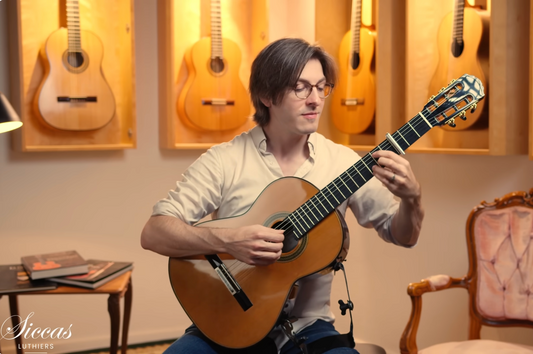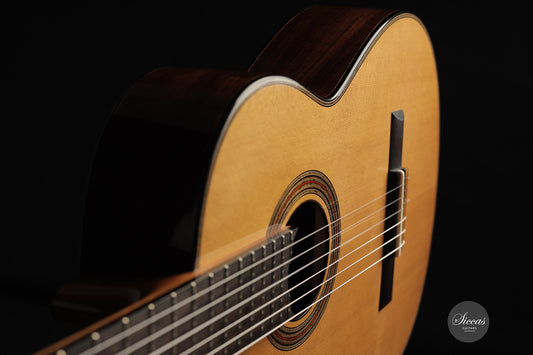





Rafal Turkowiak - 2026 - Opus Prime No.748
Rafal Turkowiak - 2026 - Opus Prime No.748
Details
Details
Overview
Overview


Video overview


More details about the guitar
About the luthier
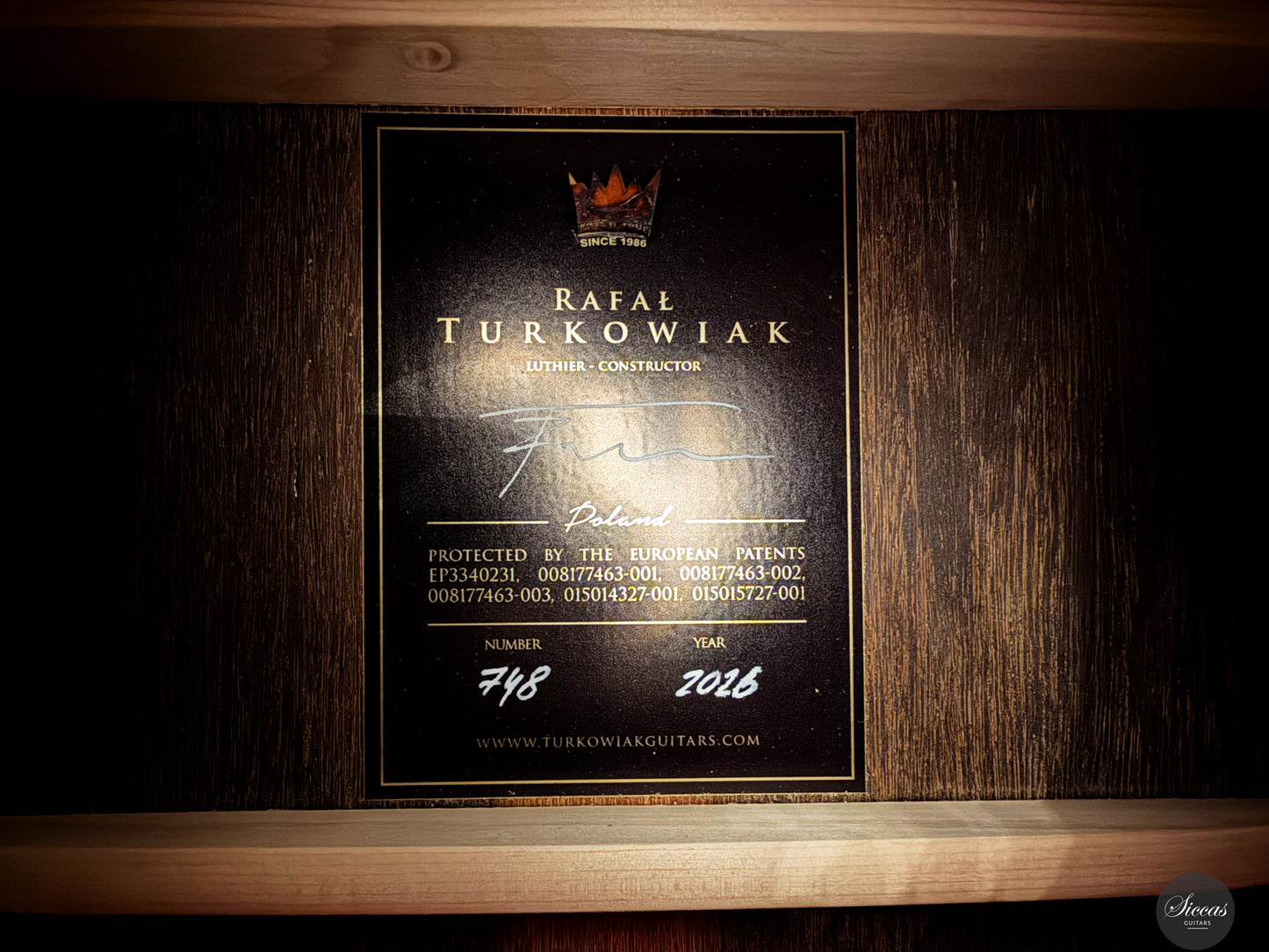
Rafal Turkowiak, born in 1966 in Golanice near Leszno, Poland, comes from a lineage of craftsmen. With a carpenter father and a wheelwright grandfather, he was immersed in woodworking traditions from an early age. Over more than twenty years of guitar making, Turkowiak has developed a distinctively scientific and forward-thinking approach to lutherie. His dedication to acoustic research led to the development of the patented “WAVE” structural concept, designed to optimise resonance and projection through internal architecture rather than external alteration.
About the guitar
The Opus Prime No. 748 from 2026 is a continuation of Turkowiak’s innovative vision, building upon his celebrated “Queen of Guitars” and earlier Opus Prime models. With a spruce soundboard paired with Bolivian rosewood back and sides, this instrument achieves a refined tonal profile that combines sweetness in the trebles with strength and sustain in the bass. The voice is full and articulate, characterised by notable clarity and depth, particularly in the lower registers.
A central feature of the design is Turkowiak’s “Acoustic Tube” system, integrated into the neck to enhance overall resonance. The exceptionally low air body resonance—between D sharp and E—contributes to a broad, grounded bass response and reinforces the instrument’s overall projection. At 1520 grams, the guitar remains lightweight and highly responsive under the right hand, offering dynamic flexibility for concert use.
Visually, the guitar maintains a clean, contemporary look with a lacquer finish and carefully profiled ergonomic features. Neck shape and body dimensions are tailored for playability, reflecting Turkowiak’s focus on the practical demands of the performing guitarist. Opus Prime No. 748 is a compelling example of how tradition and acoustic engineering can coalesce into a unified tonal and tactile experience.

While this one is sold, these are ready for you
-
Classical Guitars
The classical guitar, with its soft nylon strings and characteristic timbre, has become a symbol of chamber music, Spanish tradition, and concert repertoire. Its modern form was shaped by Antonio de Torres in the 19th century, setting the standard for the body, fan bracing, and the 65-centimeter scale length that are still used today. Instruments in this category open up a rich palette from the refined Romantic miniatures of Tárrega to the majestic concertos of Rodrigo. Here you will find guitars that preserve historical continuity and at the same time inspire new interpretations.Look all products of the collection -
Karel Dedain - 2024 - Arias
Price: 9.990 €Sale price 9.990 € Price:Unit price per Tax free (0% DE)0 €Save: -9.990 €Luthier: Karel DedainConstruction Type: Traditional -
Siccas Luthiers - Creation Doubletop Cedar
Price: 2.690 €Sale price 2.690 € Price:Unit price per Tax free (0% DE)0 €Save: -2.690 €Manufacturer: Siccas LuthiersConstruction Type: Double TopConstruction Type: Double-Top Guitars -

 Reserved
Adrian Heinzelmann - 2026
Price on requestReservedLuthier: Adrian HeinzelmannConstruction Type: Traditional -
Carsten Kobs - 2016 Double Top
Price: 17.990 €Sale price 17.990 € Price:Unit price per Tax free (0% DE)0 €Save: -17.990 €Luthier: Carsten KobsConstruction Type: Double-Top Guitars -
Zbigniew Gnatek - 2025 Lattice
Price: 11.990 €Sale price 11.990 € Price:Unit price per Tax free (0% DE)0 €Save: -11.990 €Luthier: Zbigniew GnatekConstruction Type: Lattice -
Philip Woodfield - 2008 Lattice
Price: 9.990 €Sale price 9.990 € Price:Unit price per Tax free (0% DE)0 €Save: -9.990 €Luthier: Philip WoodfieldConstruction Type: Lattice -
Pete Beer - 2026 Cir-Mheala No. 114
Price: 8.490 €Sale price 8.490 € Price:Unit price per Tax free (0% DE)0 €Save: -8.490 €Luthier: Pete BeerConstruction Type: Double-Top Guitars -
Jesus Bellido - 2026 Opus 133 Alma Aurea
Price: 5.990 €Sale price 5.990 € Price:Unit price per Tax free (0% DE)0 €Save: -5.990 €ReservedLuthier: Jesus BellidoConstruction Type: Traditional -
Oreste Lohs - 2026 No. 24
Price: 5.990 €Sale price 5.990 € Price:Unit price per Tax free (0% DE)0 €Save: -5.990 €Luthier: Oreste LohsConstruction Type: Traditional -
Michele Della Giustina - 2025 Double Top No. 438
Price: 8.990 €Sale price 8.990 € Price:Unit price per Tax free (0% DE)0 €Save: -8.990 €Luthier: Michele Della GiustinaConstruction Type: Double-Top Guitars