







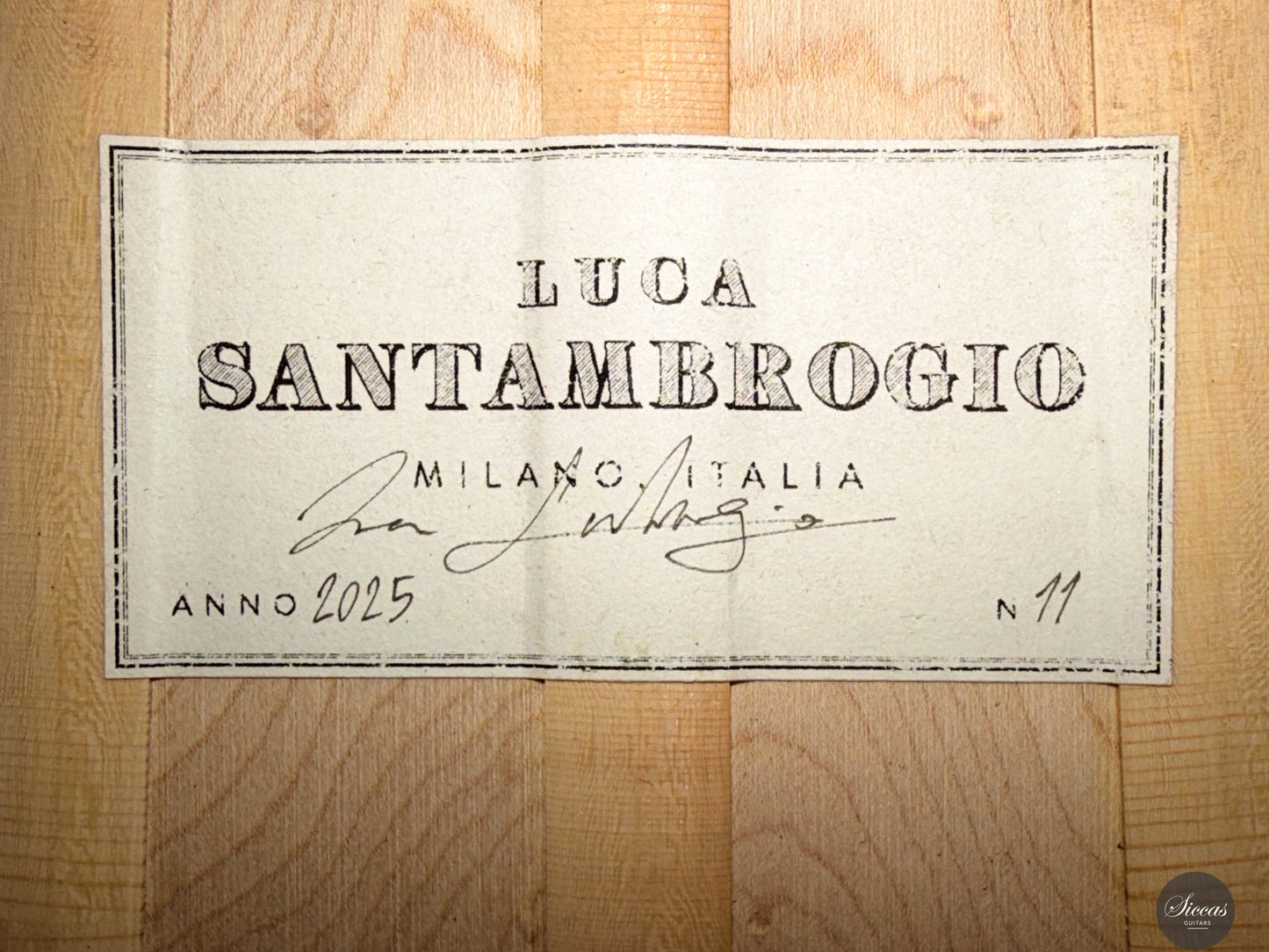
Luca Santambrogio - 2025 Torres FE24 1867
Luca Santambrogio - 2025 Torres FE24 1867


Details
Details
Overview
Overview
Shipping important note
Shipping important note
Important: Additional costs such as import taxes and custom duties may occur when importing goods from the EU into your country.
Delivery times are typically reliable and most instruments arrive within the estimated timeframe.
Should any unexpected delay occur, our team will keep you informed and provide support at every step. For all shipping details and exceptions, please see our Shipping Policy.
Details about GPSR
Details about GPSR


Video overview


More details about the guitar
About the luthier
Luca Santambrogio, born in 1995 in Desio, northern Italy, is a young luthier rooted in a region long associated with artisanal excellence. After earning a degree in industrial design, he turned to guitar making and graduated in 2022 from the Civica Scuola di Liuteria di Milano. His formative years included apprenticeships with respected luthiers Roberto De Miranda and Marco Bortolozzo, where he gained both a strong technical foundation and an appreciation for tonal refinement and visual clarity. Now working independently in Milan, Santambrogio draws on the legacies of Spanish masters like Antonio de Torres and José Luis Romanillos, crafting guitars that explore traditional construction through a highly disciplined and modern lens.
About the guitar
This 2025 traditional model by Luca Santambrogio is a tribute to Antonio de Torres’ FE24, conceived as a lightweight and responsive instrument built with historical sensibility. Weighing just 1190 grams, the guitar reflects Torres’ original structural lightness. The spruce top is paired with birdseye maple back and sides—selected not for tonal modification, but in adherence to the original FE24 materials. Although this instrument does not include a tornavoz like the historical model, it achieves a comparably low air body resonance between D sharp and E. The resulting voice is open and intimate, with a warm decay and refined balance. This is not a direct copy, but an interpretive homage: it honours Torres’ tonal and aesthetic ideals while applying Santambrogio’s own design discipline. The guitar speaks with delicacy, precision, and a clear, historically informed character.
Regular care extends the life of the instrument
Even with careful use, a classical guitar may gradually change in appearance or respond to unstable storage conditions. Have a close look at your guitar regularly and be attentif to changes. If your instrument is suffering from its environement, it will let you know.
Protect Your Guitar: Handle with Care
Be mindful when touching your instrument with greasy or unwashed hands: any skin contact is a small attack on the varnish. Of course, a guitar is made to be played, but taking a few precautions helps preserve its beauty: wash your hands before playing, wear long sleeves, and avoid unnecessary direct skin contact with the body of the instrument.
Pro tip: Avoid playing with a button-up shirt, heavy jewelry, or a belt, as these can scratch the guitar. Also, make sure your guitar case is free of any objects that could damage the instrument during storage.
String care
A good habit to adopt is wiping down your strings briefly after each playing session. This small action significantly extends their lifespan and helps maintain a consistent, comfortable feel under your fingers.
Most importantly, clean strings are essential for keeping your instrument in tune. Corrosion, sweat, and dust can affect the uniformity of the strings and interfere with accurate tuning across the entire fingerboard.
Pro tip: If you're having trouble getting your guitar in tune, it might be time to change the strings. A useful test is to compare the pitch of the 12th fret harmonic with the fretted note at the 12th fret; if there's an unusually large gap between them, your strings may have lost their integrity and should be replaced.
Keep Your Shellac Finish Shining!
Got a guitar with a shellac (French polish) finish? Here's a simple trick: Take a clean microfiber cloth and gently breathe on the surface to create a light mist. Then, softly rub to remove fingerprints, sweat, and grease. That’s usually all it takes to keep it looking great, no products needed!
Pro tip: Every few years, treat your guitar to a check-up with a luthier to keep it in top shape.
Storing Your Guitar: Climate Matters
Your guitar can safely stay outside its case, as long as the surrounding environment maintains 42–55% humidity and a temperature between 18–25°C.
Keep in mind that humidity levels can still fluctuate inside the case, especially during seasonal changes.
- Too much humidity may cause overtightened strings and a dull tone.
- Too little humidity can lead to a bulging top, string buzz, or even cracks.
Avoid placing your guitar near radiators, air conditioners, or windows with direct sunlight.
Pro tip: Always close your guitar case while playing. This helps preserve a stable microclimate inside the case, so your instrument is protected the moment you put it back in.