







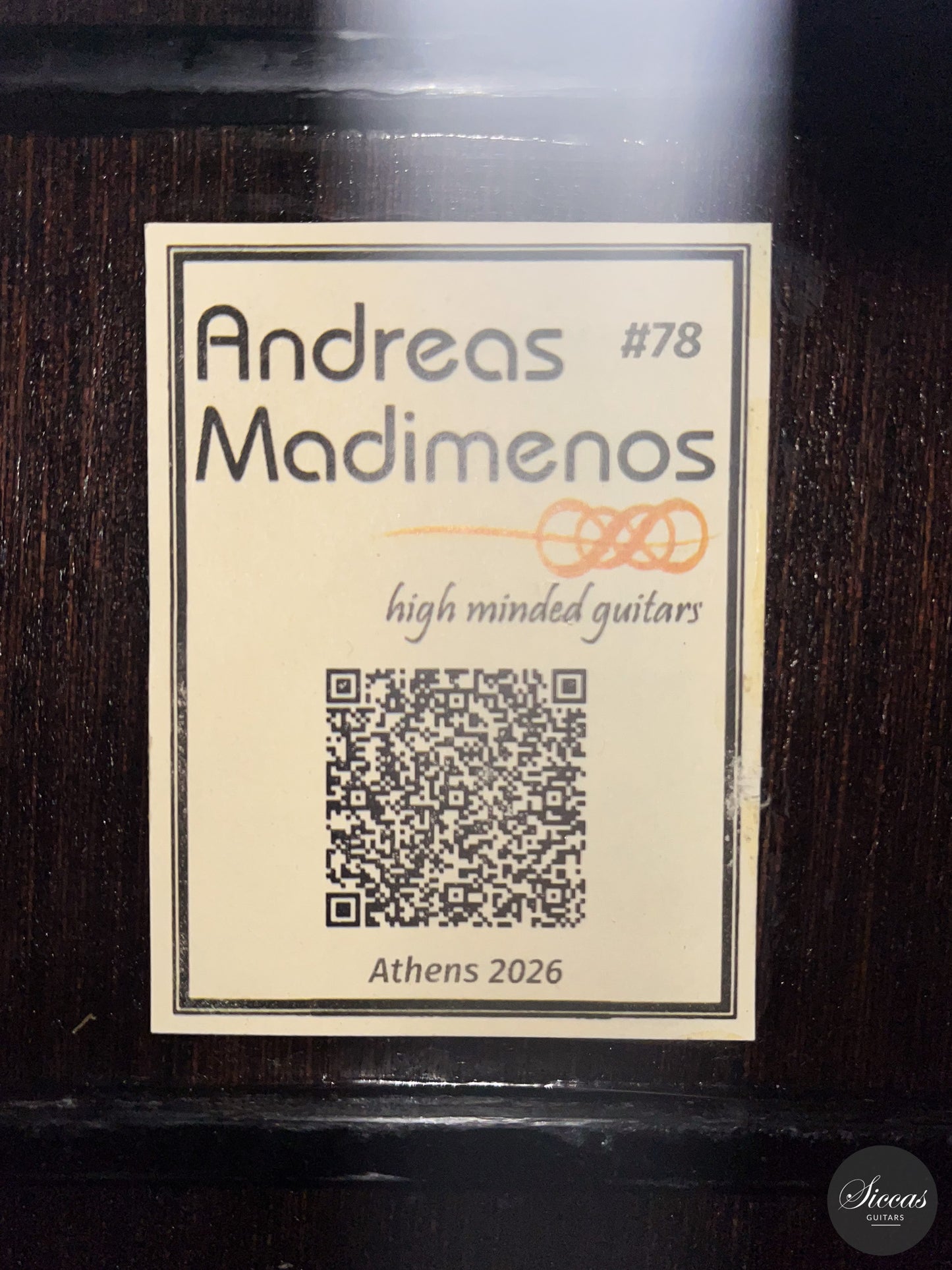
Andreas Madimenos - 2026 No. 78 Lattice
Andreas Madimenos - 2026 No. 78 Lattice


Details
Details
Overview
Overview
Shipping important note
Shipping important note
Important: Additional costs such as import taxes and custom duties may occur when importing goods from the EU into your country.
Delivery times are typically reliable and most instruments arrive within the estimated timeframe.
Should any unexpected delay occur, our team will keep you informed and provide support at every step. For all shipping details and exceptions, please see our Shipping Policy.
Details about GPSR
Details about GPSR


Video overview


More details about the guitar
About the luthier
Andreas Madimenos was born in Athens in 1984. After completing his musical studies, he went on to study Management and Financial Investments at the Athens University of Economics and Business. In 2014, he began his training in guitar making with the Greek luthier Pavlos Gypas, an experience that laid the foundation for his work as a maker.
He now works in his own fully equipped workshop, where he develops instruments that draw on both historical and modern references. His points of orientation include makers such as Vicente Arias and Johann Georg Stauffer, as well as Thomas Humphrey, Greg Smallman, and Zbigniew Gnatek. His guitars reflect a clear interest in structural development, projection, and responsiveness, always in service of musical control. Among the players who perform on his instruments is Rafael Aguirre, who uses one of Madimenos’s lattice guitars.
About the guitar
This guitar, built in 2026 as No. 78, presents Andreas Madimenos’s current approach to the lattice concept, with a design language that recalls the Australian school. The cedar top is paired with doubled ovangkol back and sides, a combination that supports a broad, powerful voice with notable depth in the bass register and a generous field of overtones. The trebles sing freely and retain body, which gives the instrument a wide tonal span across the register.
A central aspect of the construction is the internal frame developed with Charalampos Koumridis. According to the maker, this patent protected system is intended to reinforce projection, sustain, and the lower register. In playing, the result is a guitar that responds quickly, carries easily, and remains stable under changes of colour and pressure. It offers substantial dynamic capacity without losing clarity, which makes it well suited to both large scale concert literature and more contemporary playing techniques that require immediacy and control.
The visual conception is equally deliberate. The Indian rosewood bridge, the bindings, and the rosette are coordinated in colour and form, giving the instrument a unified appearance. The epoxy resin bindings are cast directly onto the body, adding an individual and coherent visual identity, while the ergonomic armrest contributes to comfort in extended playing. Handmade Pagos tuners complete an instrument whose design is guided by function, but never indifferent to refinement.
Regular care extends the life of the instrument
Even with careful use, a classical guitar may gradually change in appearance or respond to unstable storage conditions. Have a close look at your guitar regularly and be attentif to changes. If your instrument is suffering from its environement, it will let you know.
Protect Your Guitar: Handle with Care
Be mindful when touching your instrument with greasy or unwashed hands: any skin contact is a small attack on the varnish. Of course, a guitar is made to be played, but taking a few precautions helps preserve its beauty: wash your hands before playing, wear long sleeves, and avoid unnecessary direct skin contact with the body of the instrument.
Pro tip: Avoid playing with a button-up shirt, heavy jewelry, or a belt, as these can scratch the guitar. Also, make sure your guitar case is free of any objects that could damage the instrument during storage.
String care
A good habit to adopt is wiping down your strings briefly after each playing session. This small action significantly extends their lifespan and helps maintain a consistent, comfortable feel under your fingers.
Most importantly, clean strings are essential for keeping your instrument in tune. Corrosion, sweat, and dust can affect the uniformity of the strings and interfere with accurate tuning across the entire fingerboard.
Pro tip: If you're having trouble getting your guitar in tune, it might be time to change the strings. A useful test is to compare the pitch of the 12th fret harmonic with the fretted note at the 12th fret; if there's an unusually large gap between them, your strings may have lost their integrity and should be replaced.
Keep Your Shellac Finish Shining!
Got a guitar with a shellac (French polish) finish? Here's a simple trick: Take a clean microfiber cloth and gently breathe on the surface to create a light mist. Then, softly rub to remove fingerprints, sweat, and grease. That’s usually all it takes to keep it looking great, no products needed!
Pro tip: Every few years, treat your guitar to a check-up with a luthier to keep it in top shape.
Storing Your Guitar: Climate Matters
Your guitar can safely stay outside its case, as long as the surrounding environment maintains 42–55% humidity and a temperature between 18–25°C.
Keep in mind that humidity levels can still fluctuate inside the case, especially during seasonal changes.
- Too much humidity may cause overtightened strings and a dull tone.
- Too little humidity can lead to a bulging top, string buzz, or even cracks.
Avoid placing your guitar near radiators, air conditioners, or windows with direct sunlight.
Pro tip: Always close your guitar case while playing. This helps preserve a stable microclimate inside the case, so your instrument is protected the moment you put it back in.