

A Probably New Look at Hermann Hauser I and the Spanish Guitar
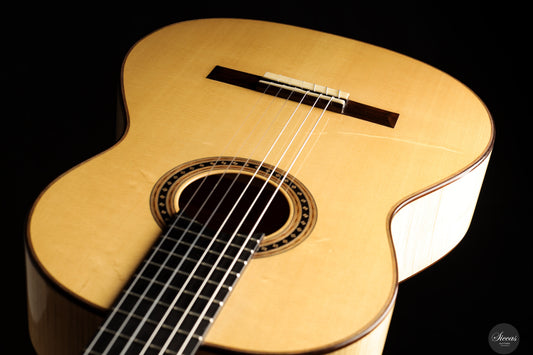
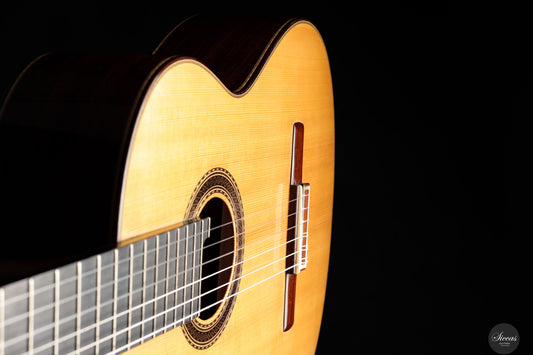
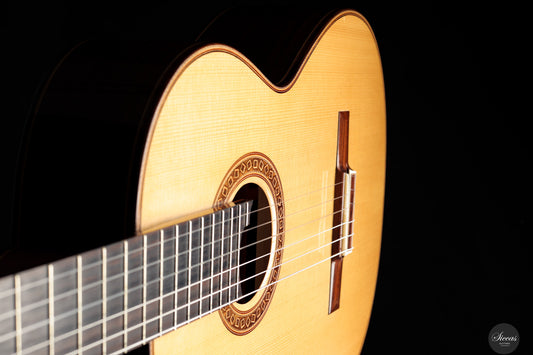
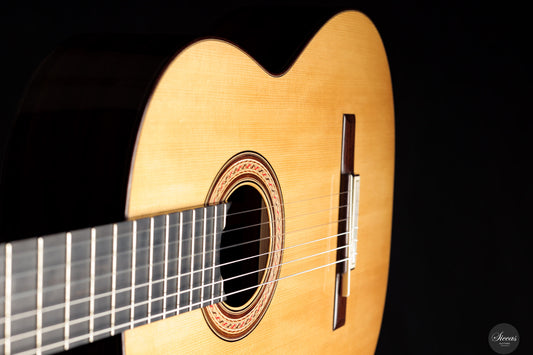
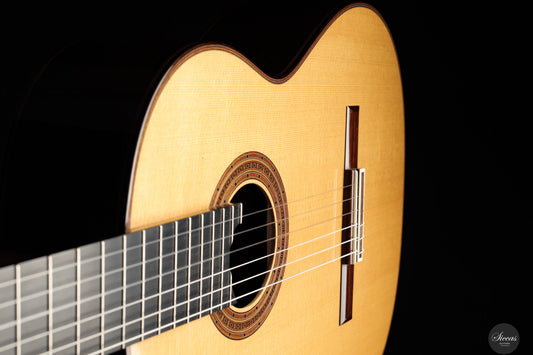
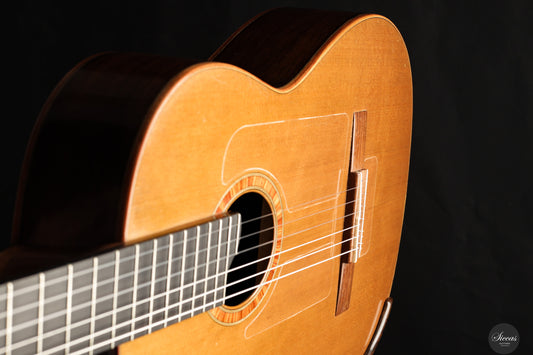
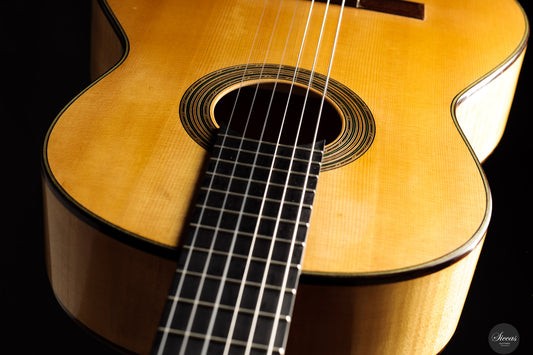
In 2017, an early guitar by Hermann Hauser I found its way into the guitarrería of his grandson, Hermann Hauser III. Nearly three decades earlier, in 1989, HH III had already carried out careful restorations on the instrument. Built in 1914, the guitar is described as so extraordinary for its time that a closer examination led to striking findings.
Distinctive features of the instrument
1. The guitar has a three-piece back. The outer wings and the sides are described as Brazilian rosewood, while the centre section is rippled maple with a central rosewood strip that creates the impression of a four-piece back. Rosewood is characterised as uncommon in German guitar construction of the period and is linked to materials used in zither making.
2. The inside of the spruce top already shows what is referred to as the Hauser Patent bracing, although HH I is said to have declared it as such only later. The patent date is given as 9 November 1920.
3. The Spanish bridge with wings shaped like a roof construction is presented as unique among Hauser guitars.
4. The plantilla is described as Spanish in form and is connected to the dimensions of the “Torres FE 09, 1859” played by Miguel Llobet.
5. The scale length, slightly under 65 cm, is also cited as pointing towards that model.
6. Side depth and the arched back are linked to traditional methods HH I used in his Viennese and Munich models.
7. White celluloid rims on back and top are highlighted, described as a relic from zither construction, along with a rosette of several wooden rings that HH III associates with Josef Hauser.
8. The machine heads are described as luxurious, with strong black rollers and a Quick Tuner on the first string. An oval hole in the headplate is noted as a traditional Hauser detail.
9. The neck is described as mahogany, glued to the body, with a flat back. The term “Albert neck” is mentioned in connection with the Munich guitarist Heinrich Albert.
Historical context and possible inspiration
On 10 November 1913, Miguel Llobet gave his first Munich concert, playing a guitar by Antonio de Torres made in 1859. HH I is said to have presented Llobet with one of his traditional maple guitars on that occasion. From 1 to 3 March 1914, Llobet performed again in Germany, in Landshut, Nuremberg and once more in Munich.
The inside of the 1914 guitar reportedly bears the inscription “10. III. 1914”. HH III is cited as stating that the inside of the top was traditionally signed and dated shortly before the body was closed, suggesting the build period may have fallen between Llobet’s two Munich visits.
Why it may have remained a single example
Several possible reasons are put forward, including the cost and scarcity of Brazilian rosewood, the expectations of clients for HH I’s established maple models, and the disruption caused by World War I (1914–1918).
Developments after 1924 and parallels
After the success of Llobet and Segovia, a major change in the German guitar scene is described. HH I is said to have turned more decisively to the Iberian tradition associated with Antonio de Torres and Manuel Ramírez. A parallel is drawn to Richard Jacob “Weissgerber” of Markneukirchen, whose work is described as influenced by Llobet’s visit in 1921. A “small Spanish model” from 1922 is mentioned as being in the collection of Christof Hanusch in Berlin.
Significance of the 1914 guitar
The instrument is presented as a link between traditional Alpine guitar making and the Spanish guitar. Its sound is described as “Spanish with German elements”. It is used to support the claim that HH I explored Spanish construction already in 1914, rather than beginning only in 1924. It is framed as a unique sound and time document within the history of international guitar construction.
Sound, playability, and aesthetics
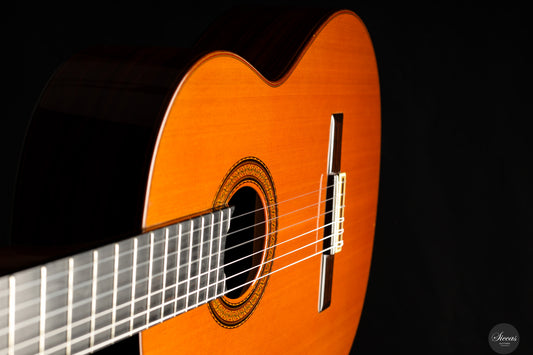
Hauser guitars are characterised by a combination of powerful, richly coloured Spanish qualities and a silvery clarity associated with music by J. S. Bach. Andrés Segovia and Julian Bream are referenced in relation to Hauser instruments. Core attributes emphasised include sound, response, playability, and tasteful aesthetics.
Karlstein, 15 July 2018
Siegfried “Hogi” Hogenmüller
Original article: read here
View the 1914 Hermann Hauser I guitar: view instrument