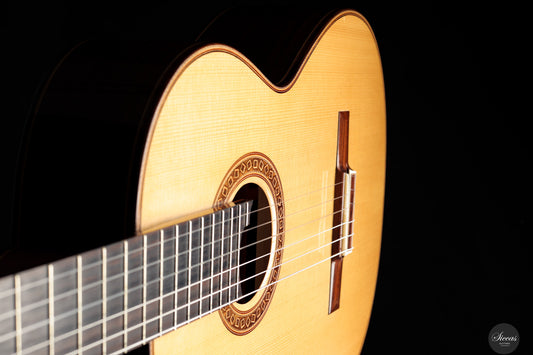


Felipe Conde – A guitar maker dynasty
1882–1937: First Period “Domingo Esteso”
Domingo Esteso is regarded as one of the most important guitar makers in the history of the Spanish guitar. He began as an apprentice in the workshop of Manuel Ramírez, and after Ramírez’s death he continued working for his widow, adding his name beside the workshop label.
In the workshop he worked alongside Santos Hernández and Enrique García, all three becoming distinguished successors to the legacy of Manuel Ramírez.
The instruments from this period retain distinctive features that set them apart, both in their refined workmanship and in their tonal qualities.
Esteso later opened his own workshop at 7 Gravina Street, working together with his wife, Nicolasa Salamanca, who lacquered the guitars. This became his most productive period, during which he created instruments of exceptional beauty and craftsmanship that have been preserved by musicians and collectors.
Many guitars were sold outside Spain, particularly in Argentina, often through the house of Romero y Fernández in Buenos Aires. This was influenced by the high value of the instruments and Spain’s economic circumstances at the time.
In 1926, his nephew Faustino Conde joined the workshop, followed in 1929 by his father Mariano Conde. These years laid the foundation for the future direction of the family workshop.
Both learned Esteso’s technique and approach to Spanish guitar making, remaining with him until his death in 1937 during the Spanish Civil War. He died of a respiratory illness aggravated by a draft in the workshop and the lack of medical treatment. Guitar production continued on a small scale until 1939.
1937–1959: Second Period “Widow and Nephews of Esteso”
After the Civil War, the label Viuda y Sobrinos de Esteso was maintained out of respect for Nicolasa Salamanca, continuing until her death in 1959.
During this period, Julio Conde, the younger brother of Faustino and Mariano, joined the workshop.
Their work followed the tradition of their uncle, introducing only modest changes to the plantilla.
Before 1953, they designed a new headstock for first-class guitars, later known as the “half-moon head”, which was used alongside the traditional Esteso design. New mosaic patterns were also introduced.
This period is distinguished by the warmth of sound achieved through the combination of tradition and the continuous search for tonal refinement led by Mariano Conde Salamanca.
Their guitars were played by professionals such as Regino Sainz de la Maza, Alirio Díaz, Quintín Esquembre and Manolo de Huelva.
In 1957, a workshop was opened in Pozuelo de Alarcón with five makers. Instruments built there bore neither signature nor internal stamp and were later described as “second guitars”.
1959–1989: Third Period “Hermanos Conde Sobrinos de Esteso”
After the death of Nicolasa Salamanca, the brothers adopted the names Sobrinos de Domingo Esteso–Conde Hermanos and later Hermanos Conde–Sobrinos de Domingo Esteso.
This became their most productive era, supplying guitars to many leading musicians including Niño Ricardo, Sabicas, Melchor de Marchena, Mario Escudero, Paco de Lucía, Paco Cepero, Enrique de Melchor, the Habichuela family, Oscar Herrero, Gerardo Núñez, Rafael Riqueni, Tomatito, Al Di Meola, John McLaughlin, Bob Dylan and Cat Stevens.
In 1960, the “half-moon head” became a trademark of the house. Modifications were made to the plantilla and the inner structure of the soundboard, and new mosaics inspired by historical embroidery were introduced.
It was during this period that palo santo was first introduced to flamenco guitars, traditionally reserved for classical guitars. Popularised by Paco de Lucía, this created the modern flamenco concert guitar known as the “Negra”, in contrast to the cypress “Blanca”.
This development produced a distinctive sound with high volume and a character recognised throughout the guitar world.
In 1971, Felipe Conde joined his father Mariano and uncle Faustino at the Gravina Street workshop, beginning the next generation.
From his father he learned respect for tradition and craftsmanship, as well as the value of direct communication with guitarists to refine the sound of the instruments.
His brother Mariano Conde Jr. joined the workshop some years later.
1980–2010: Fourth Period “Conde Hermanos Sucesores Sobrinos de Esteso”
In 1980, Mariano Conde opened a new workshop at 2 Felipe V Street, marking a new chapter with his children.
Until the death of Faustino in 1988, the family remained connected to the Gravina workshop. Thereafter, the Felipe V workshop began operating independently.
In 1989, after the death of Mariano, his sons took over the workshop.
The period initially continued established building traditions, later integrating improved materials, tools and technology while maintaining the traditional sound and fully handcrafted construction.
The Felipe V model was introduced, built with selected aged woods and detailed inlay work.
Musicians of earlier generations continued to play these guitars, joined by new artists such as Javier Conde, Roberto Morón, Lenny Kravitz, David Byrne, Sergio Vallín and many others.
During these years, Felipe Conde strengthened his international presence, presenting guitars at fairs in Frankfurt, NAMM and Japan.
2010–2019: Fifth Period “Felipe Conde Guitarrero”
In 2010, Felipe Conde began a new phase in collaboration with his children, marked by professional maturity and renewed dedication.
The influence of his father remained central, shaping his approach to craftsmanship and his relationships with guitarists.
Felipe had joined the Gravina workshop as a young apprentice in 1971, combining his training with studies and working closely with guitarists such as Niño Ricardo, Regino Sainz de la Maza, Sabicas, Mario Escudero, Melchor de Marchena and Paco de Lucía.
Dialogue with musicians remained a core principle, guiding the evolution of his instruments within the Spanish tradition.
His children María and Felipe joined the workshop, developing their own skills and building their first guitars under his guidance.
To create a more personal environment for musicians, the workshop moved to 4 Arrieta Street, opposite the historic space at Felipe V Street, where professionals and enthusiasts are welcomed to explore his guitars.