

Ennio Giovanetti
Philosophy and Approach
The construction of classical concert guitars began in 1998, after enrolling at the School of Lutherie in Milan with an initially different goal in mind. Through visits to and exchanges with various luthiers’ workshops, a deep fascination developed for an instrument that had previously been considered of secondary importance. Over time, its rich tonal and expressive qualities became increasingly evident.
This growing interest led to an ongoing exploration of different schools of thought in guitar making. Starting with the historical instruments of Antonio de Torres, Hermann Hauser and Simplicio, this path expanded to include encounters with luthiers from different generations, both historical and contemporary. The aim of this process has been to understand the origins of the ideas and intuitions that shaped the classical guitar into its present form, and to explore how these concepts can be further developed and applied in modern guitar construction. The resulting conclusions are not expressed verbally, but rather through the sound and character of the instruments themselves.
Materials and Craftsmanship
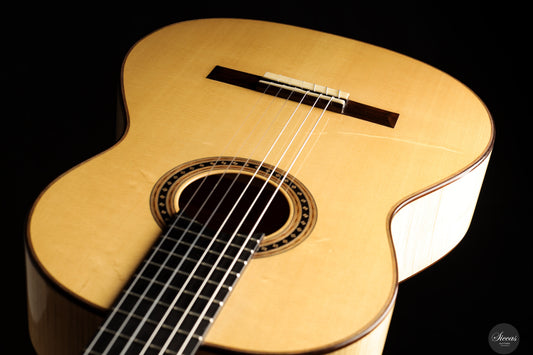
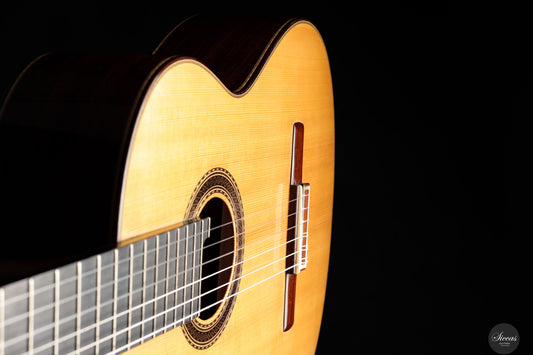
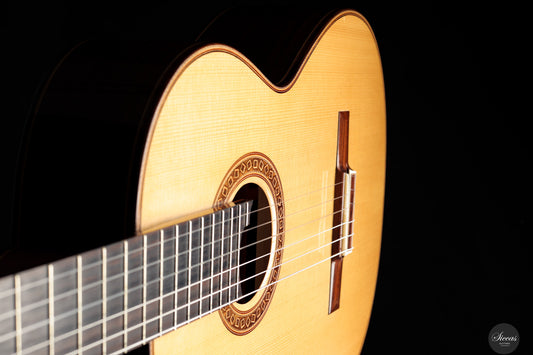
The guitars are the result of careful and meticulous hand craftsmanship, allowing each phase of construction to be followed with precision and attention. This approach, combined with the use of selected and well-seasoned tonewoods, ensures a consistently high standard in both sound quality and structural integrity.
Only non-synthetic glues are used, and the instruments are finished with natural resins. The woods are carefully chosen to exclude material from cultivated sources, ensuring a naturally grown structure without forced development. This selection process contributes not only to the aesthetic qualities of the instruments, but also to their sonic depth and authenticity.